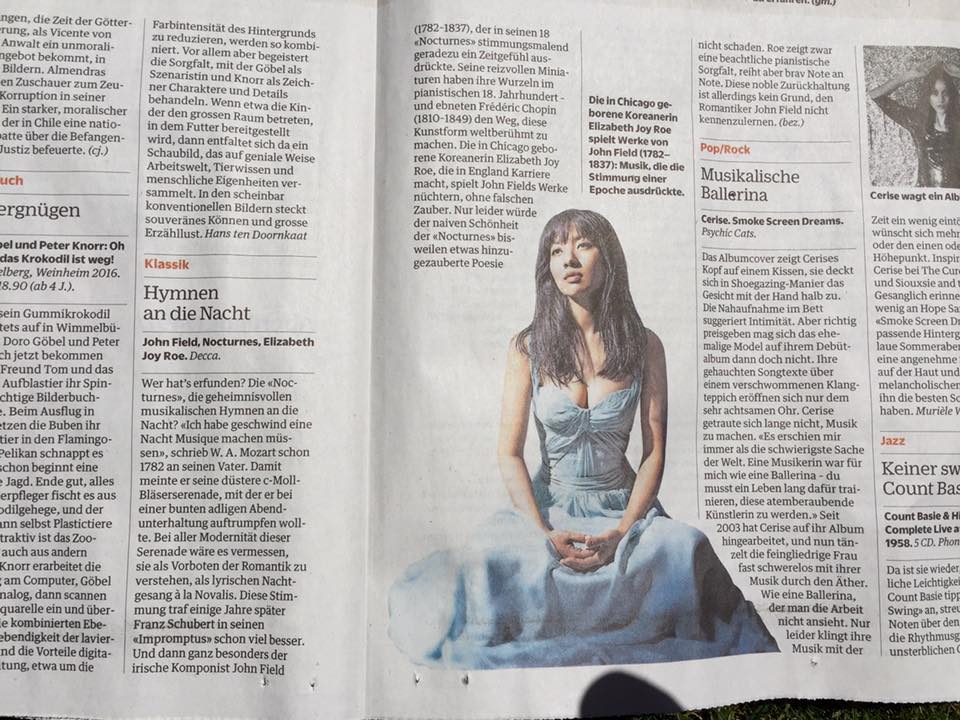
Elizabeth's latest album of the complete Field Nocturnes is continuing to receive accolades:
Classical Ear:
5 STARS ... Elizabeth Joy Roe is revealed as an intelligently expressive, deeply nuanced advocate. In one nimbly graceful performance after another she lifts Field’s music out of the long, twilit shadows of Chopin’s later assumption of the nocturne to make substantial and persuasive claims for their own manners and merits. There’s much to enjoy in playing of liquescently sensitive technical precision that exquisitely encapsulates Roe’s description of the nocturnes in her excellent booklet note as “half-waking dreams in a night without gloom”. The overall effect is intimate, intense and involving in equal measure, the recording beautifully framed in Suffolk’s Potton Hall. In a word: sublime.
The Washington Post:
The American pianist Elizabeth Joy Roe (of the popular piano duo Anderson and Roe) has been fascinated by Field’s nocturnes since her student years at Juilliard. Now she’s compiled a generous 86 minutes of them on a new album. There was more than just recording the beautiful music. Roe conducted considerable research on Field, hunting for definitive sources, which survive in various editions (one revised by Liszt in 1859) and numbering sequences.
Field, who was born in Dublin in 1782 but spent most of his career in Russia, forged a new style. His slow-paced, lyrical nocturnes are ripe with emotive gestures and flights of fancy. Imbued with lilting melodies, the pieces often sound like wordless songs or operatic arias. Although as Roe points out in the booklet notes, their musical DNA relates to slow movements in Mozart or Beethoven, the sound is uniquely Field’s. His oversized personality — fueled by wit and alcohol — reportedly matched his enormous success.
In nocturnes such as Nos. 1, 5 and 6, Roe skillfully displays Field’s recipe of a singable, ornamented melody in the right hand accompanied by rippling arpeggios or widely spaced chords in the left. No. 4 might be the most beautiful, its bittersweet tune unfolding in Roe’s pearly runs with crepuscular harmonies. A few nocturnes break the mold. No. 13 mesmerizes with the melody in block chords in the left hand, while the right ladles on a repeated theme above. No. 16 plays like a scene from a Donizetti opera, its sweeping lyricism punctuated by dramatic asides, while No. 12 lopes along with a jaunty tune.
Field’s nocturnes have similar moods, but careful listening reveals that Roe makes each an individual portrait.